
How to Choose a Rotary Hammer by Drilling Capacity
Drilling capacity is the maximum hole diameter a rotary hammer is rated to cut in a named material, normally concrete. YOWEL SDS-Plus models are rated 20, 22, 26 or 28 mm in concrete; choose by the diameter you drill every day, using the rated maximum only as headroom for occasional holes.
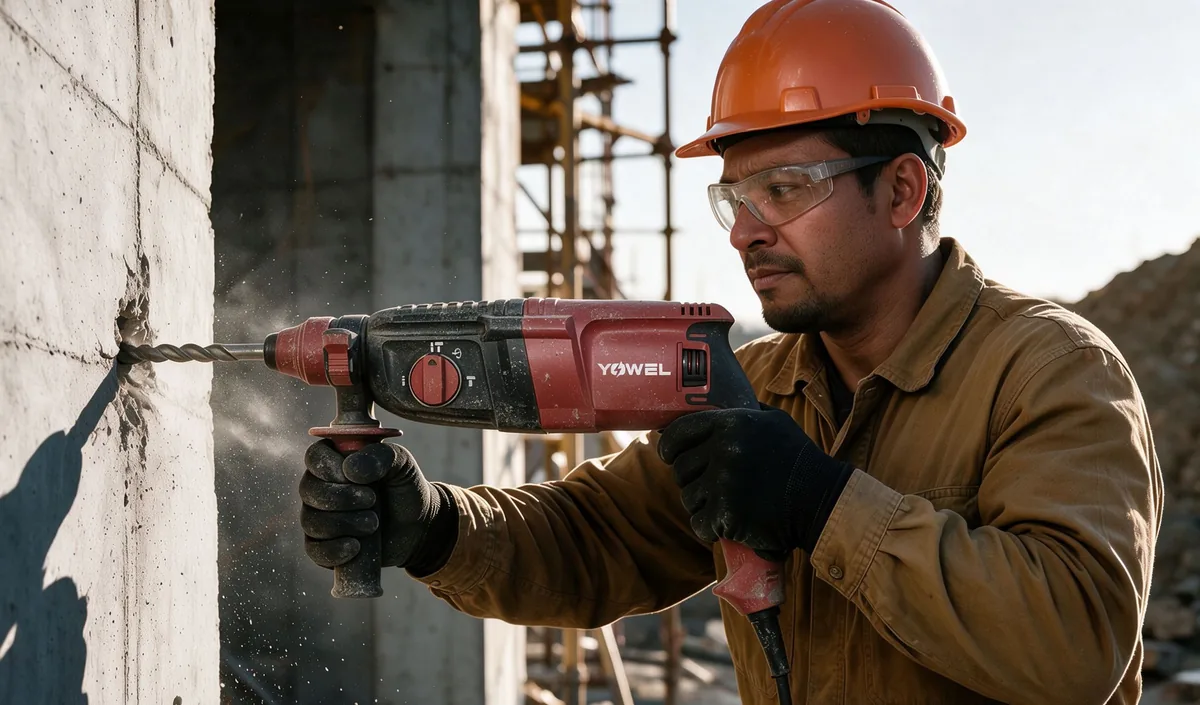
Quick answer (TL;DR)
Drilling capacity is the largest hole diameter a rotary hammer is rated to make in a named material — usually concrete. Choose the class by the holes you drill most often, not by the biggest number on the box: match the optimum drilling range (6–18 mm for a 26 mm-class tool) to your everyday anchor diameters, and keep the rated maximum as headroom for occasional large holes. On a factory specification sheet, the only line that defines capacity is "Max drilling capacity / Concrete". Model names and catalogue folders are navigation labels, not measurements.
Three checks settle almost every selection: the material you drill most, the diameter you drill most, and how long the tool runs per hour. Input power, impact energy and corded-versus-cordless come after those.
1. What "drilling capacity" actually means
A rotary hammer does not have one capacity. It has at least three, because concrete, steel and timber fail in completely different ways. A specification sheet that quotes a single number without naming the material is incomplete.
| Material | What the number describes | Across the YOWEL range (19 models) |
|---|---|---|
| Concrete | Maximum diameter in hammer-drilling mode, with an SDS-Plus bit | 20 / 22 / 26 / 28 mm, depending on model |
| Steel | Maximum diameter in rotation-only mode | 13 mm on every model |
| Wood | Maximum diameter in rotation-only mode | 30 mm on every model |
So "a 26 mm rotary hammer" means 26 mm in concrete. It does not mean 26 mm in steel, and it does not mean every 26 mm hole is equally easy to produce. The steel and wood figures belong to a different operating mode entirely. When two quotes look similar, the first question is always: capacity in which material?
Definition: Drilling capacity in concrete is the maximum hole diameter a rotary hammer is rated to produce in concrete in hammer-drilling mode. It is a ceiling, not a recommended working size.
2. Why the model number is not the capacity
On a factory sheet these are two different fields, and confusing them changes what you order. A model name is a part number. A catalogue folder is a navigation grouping. Neither is a measurement. The measurement is the Max drilling capacity / Concrete row of the approved parameter sheet.
In the current YOWEL range, several models sit in a folder whose name does not match their measured concrete capacity:
| Model(s) | Catalogue group | Name suggests | Measured max. in concrete |
|---|---|---|---|
| RH2820 | 28mm Rotary Hammer | 28 mm | 26 mm |
| RH3018 / RH3020 | 30mm Rotary Hammer | 30 mm | 28 mm |
| LRH2601–LRH2614 (8 models) | Cordless Rotary Hammers | 26 mm | 22 mm |
| RH2001 | 20mm Rotary Hammer | 20 mm | 20 mm (matches) |
Build a purchase order from folder names and you will over-specify some models and under-specify others. The RH2820 specification page is a useful cross-check: the model is filed under 28 mm, yet its full specification table lists 26 mm in concrete, 850 W and 3.1 J. Those numbers, not the digits in the name, describe what the tool will do on site.
This is also why a capacity page should be built from measured values. Our 26 mm class page groups seven models by their rated concrete capacity — six RH26xx models plus the RH2820 — rather than by the folder their photographs were filed in.
Rule: select from the parameter-sheet value, then confirm it on the individual model page before ordering.
3. Start from the holes you drill, not the biggest number
The headline capacity is a ceiling. The figure that predicts day-to-day productivity is the optimum drilling range — the band of diameters the tool is designed to work in repeatedly.
| Class | Rated max. in concrete | Optimum working range | Typical everyday work |
|---|---|---|---|
| 20 mm | 20 mm | 4–12 mm | Light fixings, small anchors, interior work |
| 22 mm | 22 mm | 6–16 mm (corded) / 6–18 mm (cordless) | General fixings, block and masonry |
| 26 mm | 26 mm | 6–18 mm | Structural anchors, repeated concrete holes |
| 28 mm | 28 mm | 6–20 mm | Larger anchors, heavier concrete work |
A 26 mm-class hammer spends most of its life drilling 6–18 mm holes, hundreds of them, in cured concrete. Working continuously at the rated ceiling is a different job: it loads the motor, heats the gear case and wears brushes and grease faster. Our corded models are specified for a 40% intermittent duty cycle, so sustained maximum-diameter work needs a work plan, not simply a bigger tool.
The practical consequence is simple. If almost all of your holes are 10 mm anchors, a 20 mm or 22 mm class machine is usually the better match on weight, handling and fatigue. Move up to the 26 mm or 28 mm class when your hole schedule genuinely includes 18–24 mm anchors, or when you need headroom for occasional through-holes and chiselling.
The RH2601 800W SDS-Plus rotary hammer is a representative 26 mm-class tool: 800 W, 3.0 J, 26 mm in concrete, optimum 6–18 mm, three working modes and an SDS-Plus holder. Its full specification table is a useful template for comparing any two quotes line by line.
4. The four capacity classes in the YOWEL range
| Class (concrete) | Models | Input power | Impact energy | Optimum range | Power system |
|---|---|---|---|---|---|
| 20 mm | 1 (RH2001) | 500 W | 1.7 J | 4–12 mm | Corded, 2 modes |
| 22 mm | 9 (RH2220 + 8 cordless) | 720 W / DC21V | 2.0 J / 2.7 J | 6–16 / 6–18 mm | Corded + 21V cordless |
| 26 mm | 7 | 800 W (850 W on RH2820) | 3.0 J (3.1 J on RH2820) | 6–18 mm | Corded, 3 modes |
| 28 mm | 2 (RH3018, RH3020) | 900 W | 3.2 J | 6–20 mm | Corded, 3 modes |
All 19 models use an SDS-Plus tool holder and are rated 13 mm in steel and 30 mm in wood. Capacity class and power system are independent choices — see section 6. Browse the full rotary hammer catalogue for all 19 models, or go directly to the 26 mm class page to compare the seven measured 26 mm machines.
5. A six-step selection method
- List the hole diameters you drill in a normal week, with approximate counts for each.
- Name the dominant material — cast concrete, block, brick, steel or timber.
- Split "everyday" from "occasional" diameters. A single 24 mm through-hole per week is not a reason to size the whole fleet for 24 mm.
- Choose the class whose optimum range covers the everyday band, and keep the rated maximum as headroom for the occasional band.
- Check the duty cycle against your shift pattern, and confirm mains voltage and plug standard for the destination market.
- Open the model page and verify the
Max drilling capacityrow, impact energy, tool holder and function modes before requesting a quote.
6. Corded or cordless is the second decision, not the first
Capacity does not tell you how a tool is powered. In the YOWEL range the 22 mm class contains both a 720 W corded model (RH2220) and eight DC21V cordless models, all rated 22 mm in concrete; the cordless models are listed at 2.7 J. Settle the capacity first, then choose the power system from site conditions: mains availability, work at height, indoor fit-out, runtime and battery logistics. A cordless tool does not automatically have a lower capacity, and a corded tool does not automatically have a higher one.
7. How to verify a supplier's capacity claim
Before you compare prices, make the supplier's numbers comparable. Ask for:
- the full specification table, not a product card with three headline figures;
- the material each capacity figure refers to;
- the optimum drilling range, not only the maximum;
- the duty cycle and the test basis behind the rating;
- confirmation of tool holder and function modes for the exact model quoted.
Then cross-check the answer against the individual model page. On our own documentation, the electrical and performance figures come from a single approved parameter sheet and the commercial figures from a separate business-terms sheet; the two are deliberately kept apart so a capacity value can never be confused with an order term. Certification names (CE / GS / EMC / ROHS / ISO) are recorded as supplied by our business team — certificate numbers, scopes and scans must be verified before any compliance claim is made. Our technical support team can help check a specification against your market before you commit.
8. Five mistakes that cost buyers money
- Buying the largest number in the catalogue. A 28 mm-class machine used all day on 8 mm anchors is heavier, slower and more tiring than a 20 or 22 mm machine doing the same holes.
- Reading a folder name as a measurement. As shown above, RH2820 is a 26 mm machine in measured concrete capacity.
- Comparing a wood or steel figure with a concrete figure. 30 mm in timber is not 30 mm in concrete.
- Ignoring the optimum range. It is the best available predictor of how the tool behaves across a normal working week.
- Skipping the duty cycle. A 40% intermittent rating means continuous production needs rest periods or more than one tool per operator.
FAQ
What does 26 mm mean on a rotary hammer?
On a rotary hammer, 26 mm normally means the maximum hole diameter the tool is rated to drill in concrete using hammer-drilling mode. It is not a steel or timber figure — YOWEL models are rated 13 mm in steel and 30 mm in wood regardless of class — and it is a ceiling rather than a recommended everyday size.
Is a higher drilling capacity always better?
No. A higher capacity class brings more input power, more impact energy and usually more weight, and it is only worth carrying when your hole schedule includes larger diameters or sustained heavy concrete work. For repeated small anchors, the lower class is typically more comfortable and more economical; the optimum drilling range is the better guide than the headline maximum.
Can a 26 mm rotary hammer drill 26 mm holes all day?
Not as a continuous production method. The 26 mm figure is a rated maximum; YOWEL's 26 mm-class corded models carry a 40% intermittent duty specification (40% run, 60% rest in a ten-minute window). Repeated drilling should sit inside the 6–18 mm optimum range, with maximum-diameter holes treated as occasional work.
Does cordless change the drilling capacity?
Not by itself. Capacity is a mechanical rating in a named material. The YOWEL 22 mm class includes both a 720 W corded model and eight DC21V cordless models, all rated 22 mm in concrete. Choose the capacity from the holes you drill, then choose corded or cordless from site conditions, runtime and battery logistics.
Why does a model called RH2820 have a 26 mm concrete rating?
Because the model name is a factory part number and the "28mm" catalogue folder is a navigation group; neither is a measurement. The Max drilling capacity / Concrete row on the approved parameter sheet is the rated value, and for the RH2820 it reads 26 mm alongside 850 W and 3.1 J. Always select from that row on the individual specification page.
Conclusion
Choose a rotary hammer from the holes in front of you. Name the material, measure the diameters you actually drill, match the optimum working range, and treat the rated maximum as headroom. Then verify the figure on the model's own specification page, because a part number or a folder label is not a measurement. If you want a second pair of eyes on a hole schedule, our Taizhou factory team has been building and developing rotary hammers for over 20 years, and we can check the specification against your market before you commit.
About the data. All electrical and performance figures in this guide come from the approved YOWEL product parameter sheet (user-approved version); capacity classes are grouped by the "Max drilling capacity / Concrete" row. Commercial figures come from the separate confirmed business-terms sheet (MOQ 500 pcs, lead time 35–40 days, FOB / CFR / CIF, QC sampling to ANSI/ASQC Z1.4 / GB/T 2828.1). Factory facts: 20+ years of rotary hammer production and R&D, 30,000 m², 200 staff, 4 production lines, 600,000 units annual capacity. Certificate names only are recorded; no certificate numbers, scans, compliance claims, customer cases, prices or market statistics are asserted here. Confirm every value on the individual model page before ordering.
Last reviewed on 14 November 2026 by the YOWEL factory engineering team · ZHEJIANG YOUWEI TOOLS CO.,LTD. · No.85 Taojiang Road, Qiansuo Industrial Zone, Jiaojiang District, Taizhou, Zhejiang, China · [email protected] · +86 178 1658 8178