
SDS-Plus Explained: Bits, Modes and Maintenance
SDS-Plus is a quick-change tool-holder system for rotary hammers; it names the shank and chuck interface, not a hole diameter. All 19 YOWEL rotary hammers use SDS-Plus, in two-function or three-function versions, with bits and chisels available to order separately.
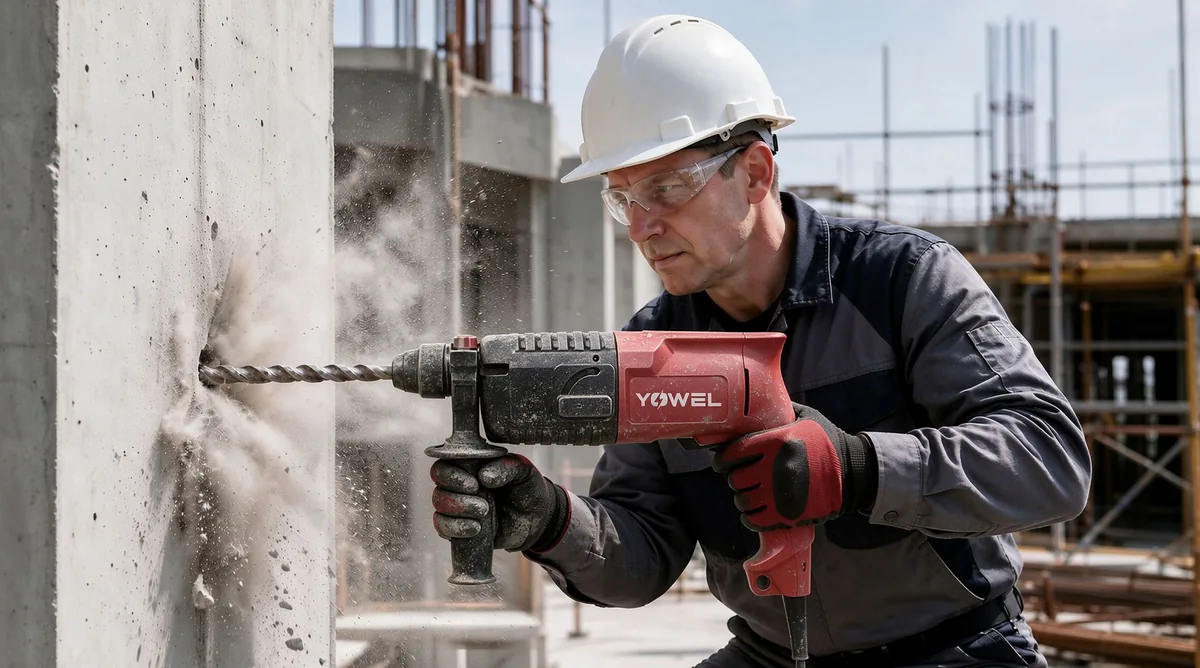
Quick answer (TL;DR)
SDS-Plus is a tool-holder and bit-shank standard, not a list of machine features. It tells you which bits fit and how impact reaches the bit. It does not tell you how many working modes the hammer has, what diameter it can drill in concrete, or whether it runs on mains power or a battery. Those are separate rows on the specification sheet.
Three rules prevent most buying and maintenance mistakes: choose bits from the material and hole you actually drill; read the Functions row for the exact model before assuming a chiselling mode exists; and treat the dust and heat you can see on site as the real maintenance signal. All 19 YOWEL models carry an SDS-Plus holder and all 19 now have a published Functions row: 18 are three-mode, and the RH2001 is the single two-mode exception.
1. What SDS-Plus defines — and what it does not
Most confusion starts with one word doing too much work. "SDS-Plus" describes the interface between a bit and a tool holder. It is not a size class, not a power rating and not a feature list. A machine can be SDS-Plus and still be small, large, two-mode, three-mode, corded or cordless.
| SDS-Plus defines | SDS-Plus does not define |
|---|---|
| Which bit shank fits the chuck | How many working modes the machine has |
| How the bit is retained while still free to slide axially | Maximum hole diameter in concrete |
| How hammer energy is delivered along the bit axis | Input power, impact energy, speed or weight |
| A common interface across tool and bit makers | Whether the tool is corded or battery powered |
| That a rotation-only mode uses a different bit type | Any accessory, case or maintenance interval supplied with the tool |
Definition: SDS-Plus is a nominal 10 mm grooved bit shank with a matching spring-loaded tool holder in which the bit can move axially, so the hammer mechanism delivers impact along the bit while the grooves transmit rotation. That sliding movement is the whole point: a conventional three-jaw chuck grips a bit rigidly and is not designed to deliver comparable hammer energy.
2. Why a sliding shank matters on site
In rotation-only mode, the chuck drives the bit round and the operator supplies the feed pressure. In hammer-drilling mode, a piston drives a striker that hits the back of the bit many thousands of times per minute. If the bit were clamped rigidly, that energy would be absorbed by the chuck and the gear case instead of reaching the concrete. The grooves let the bit float a few millimetres along its axis while staying positively located.
This has two practical consequences. First, the shank and the chuck nose must be clean: grit in the grooves stops the bit floating and turns an impact mechanism into a hammer beating on its own housing. Second, an SDS-Plus bit should never be treated as a general-purpose round-shank bit. Adapters exist for rotation-only work, but heavy hammer-drilling through a three-jaw adapter is a misuse of the system. Where an adapter is needed, follow the manual supplied with the machine rather than a workshop habit.
3. Choose the bit by material and hole, not by the biggest number
A bit is chosen for a material, a diameter and a mode. Our approved parameter sheet states the same steel and timber maxima for all 19 models, while the concrete figure changes by class:
| Work | Mode on the machine | Rated maximum on our sheet | What to verify before buying bits |
|---|---|---|---|
| Concrete / masonry | Hammer drilling | 20 / 22 / 26 / 28 mm, depending on model | The Max drilling capacity / Concrete row for your exact model |
| Steel | Rotation only | 13 mm on every model | A suitable bit and, if specified for your model, an adapter |
| Wood | Rotation only | 30 mm on every model | Hammer action switched off; no impact on timber |
| Repeated fixings | Hammer drilling | Optimum range, not the maximum | 4–12 mm on the RH2001; 6–18 mm on the 26 mm class |
That last row is the one buyers skip. The rated maximum is a ceiling; the optimum drilling range is the band the machine is designed to work in all week. Sizing a fleet of bits around a maximum-diameter hole you drill once a month wastes money and wears tools faster. Our guide to choosing by drilling capacity sets out the selection method; this article deals with what happens at the chuck end of that decision.
4. Modes belong to the machine, not to SDS-Plus
Here is the assumption that costs importers the most: a buyer reads "SDS-Plus" and concludes every machine in the range can chisel. It cannot be concluded. On our approved parameter sheet, Functions is a separate row, and the 19 models do not share one value.
| Functions row on the parameter sheet | Models | What a buyer can rely on |
|---|---|---|
| Two functions | 1 corded (RH2001) | Drilling / Hammer drilling. No chiselling mode. |
| Three functions | 10 corded (RH2220, RH2601–2604, RH2618, RH2620, RH2820, RH3018, RH3020) | Drilling / Hammer drilling / Chiselling, including a chiselling-only setting |
| Three functions | 8 cordless (LRH2601–2604, LRH2611–2614) | Drilling / Hammer drilling / Chiselling — confirmed by our business team on 14 November 2026 |
Compare the RH2001 two-mode SDS-Plus hammer with the RH2601 800W three-mode specification page: the same bit interface, the same 13 mm steel and 30 mm wood ratings, but a different Functions row and a different job. A buyer ordering tile-removal chisels for an RH2001 would be disappointed, and the word "SDS-Plus" would never have warned them.
The eight DC21V cordless models now carry the same three-position Functions row as the three-mode corded machines: drilling, hammer drilling and chiselling. That entry was confirmed by our business team on 14 November 2026 and added to the approved parameter sheet; before that date the cordless section of the sheet had no Functions column at all. We state the date of the correction rather than quietly presenting it as if it had always been there. The mode set is a published specification now, not an inference from the SDS-Plus holder — but still confirm the exact configuration in writing against your model numbers before placing an order.
5. The two rows worth reading before you order
When two quotations look similar, open both specification pages and compare the same rows. Here are the real values for the two machines used as examples above:
| Specification row | RH2001 | RH2601 |
|---|---|---|
| Tool holder | SDS-Plus | SDS-Plus |
| Functions | Drilling / Hammer drilling | Drilling / Hammer drilling / Chiselling |
| Input power | 500 W | 800 W |
| Impact energy | 1.7 J | 3.0 J |
| Max drilling capacity | Concrete 20 / Steel 13 / Wood 30 mm | Concrete 26 / Steel 13 / Wood 30 mm |
| Optimum drilling range | 4–12 mm | 6–18 mm |
| Work system | 40% intermittent duty | 40% intermittent duty |
| Net weight | Approx. 2.3 kg | Approx. 2.8 kg |
Tool holder tells you what fits. Functions tells you what the machine can do. Everything else in the table is a separate decision. We keep electrical and performance figures on one approved sheet and commercial terms on another, so a capacity value can never be mistaken for an order term.
6. A five-step bit-selection routine
- Name the material and the hole diameter you drill most often, not the largest hole in the catalogue.
- Set the mode. Hammer drilling for concrete and masonry; rotation only for steel and timber; chiselling only if the Functions row for your model lists it.
- Check the diameter against the optimum range on the model page, keeping the rated concrete maximum as headroom for occasional work.
- Match the shank to the holder. An SDS-Plus bit for an SDS-Plus chuck; anything else needs the adapter specified in your manual.
- Confirm the accessory list in writing. We have not published a per-model bit or accessory list yet, so do not build a purchase order from a generic kit.
7. Signs a bit is past its best
The following are widely recognised jobsite indicators, not results from a YOWEL laboratory test. They are worth teaching to every operator because a worn bit costs more in heat and labour than in replacement steel:
- Progress slows while the machine sounds unchanged. The carbide edge has stopped cutting and the hammer is pulverising instead.
- Dust becomes fine and pale, and the hole polish changes. Fine dust often means grinding rather than chipping.
- The chuck nose or bit shank runs hot to the touch after a short run, or the flutes are packed with concrete dust.
- The cutting edge is chipped, rounded or blue-discoloured, or the flutes are worn smooth near the tip.
- The bit no longer slides freely in and out of the holder, or will not lock positively.
Worn bits make the motor work harder, and heat is the enemy of grease, brushes and seals. Replacing a bit early is cheaper than rebuilding a gearbox.
8. A six-step care routine for the bit and chuck
This is the routine we recommend as a baseline. It deliberately contains no invented interval or consumable grade — where our documentation is silent, it says so.
- Isolate the tool. Unplug it or remove the battery before touching the chuck.
- Remove and inspect the bit. Wipe the shank clean; check the grooves for burrs, rust and packed dust.
- Clear the chuck nose. Brush out dust and wipe the outside. Never flush solvent into the mechanism.
- Lubricate only as specified. If your model manual names a grease, apply a thin film to the shank only. We do not publish a grease grade or a fixed regreasing interval, so do not substitute a workshop guess for the manual.
- Refit and verify. The bit must lock positively and still move axially. A bit that binds is a fault, not a tight fit.
- Respect the duty rating and let it cool. Our corded models are specified for 40% intermittent duty. Rest periods are part of maintenance; wipe the tool down and store it dry afterwards.
9. What maintenance actually changes tool life
Three things dominate, and none of them is a secret additive. Dust control keeps grit out of the grooves and the chuck. Heat control — respecting the 40% intermittent duty rating, keeping ventilation paths clear and letting the tool cool — protects grease, brushes and seals. Correct mode use stops an operator running hammer action into timber or steel, and stops anyone attempting chiselling on a two-mode machine. Our technical support team can check a configuration against your market before a container is committed.
We would rather be explicit about the limit of our published documentation than fill it with plausible numbers. We do not currently publish per-model spare-parts lists, carbon-brush dimensions, grease grades, regreasing intervals or service manuals. We do publish a platform exploded view on our service and support page, which shows how the SDS-Plus platform breaks down into chuck, gearbox, hammer mechanism, motor and switch — but not the part numbers, which are issued per model. Until those lists are released, gearbox and motor repairs belong with a qualified service centre using the correct parts — not with a screwdriver and a guess.
10. What we publish, and what we still owe you
| Information | Status on this site |
|---|---|
| Electrical and performance specification per model | Published on each model page, from the approved parameter sheet |
| Tool holder and duty cycle for corded models | Published per model |
| Functions row for all 19 models | Published per model — 1 two-mode RH2001, 18 three-mode including all 8 cordless models (confirmed 14 November 2026) |
| Per-model bit and accessory list | Not published yet |
| Grease grade, carbon-brush size, regreasing interval | Not published yet |
| Per-model spare-parts lists and service manuals | Not published yet — a platform exploded view is published on the service page |
| Certificates | Names only (CE / GS / EMC / ROHS / ISO) as supplied by our business team; no numbers, scans or compliance claims |
That table is not a disclaimer to hide behind. It is the honest answer to "what can I verify before I buy?" If a figure matters to your order, confirm the configuration with us and we will put it in writing against the model number.
11. SDS-Plus and drilling capacity are independent decisions
Every one of our 19 models uses an SDS-Plus holder, yet they span four concrete capacity classes. The holder does not decide the class; the Max drilling capacity / Concrete row does, and the folder a photograph was filed in is only a navigation label. Our 26 mm class page groups seven measured 26 mm machines by that row — including the RH2820, whose name and folder suggest 28 mm. Browse the full rotary hammer catalogue to compare all 19 models, then read the Functions row on the individual page before choosing bits.
FAQ
Is SDS-Plus the same as SDS-Max?
No. SDS-Max is a larger shank and holder system intended for heavier breaking work, with a different bit range. Our current range is SDS-Plus only: we do not list an SDS-Max model and we will not point you to a product page that does not exist. If your application needs that class of machine, tell us the hole diameters and material and we will discuss what we can actually supply.
Can I fit an SDS-Plus bit in a standard three-jaw drill chuck?
Not usefully. A grooved SDS-Plus shank is designed to slide in a matching holder, and a three-jaw chuck grips a round shank rigidly. Adapters are made for rotation-only work, but heavy hammer-drilling through an adapter is a misuse of both parts. Use the bit the machine was designed for and follow the manual supplied with your model.
Does SDS-Plus mean the hammer has a chiselling mode?
No. Working modes are a machine specification, not part of the holder standard. On our parameter sheet, one model (RH2001) is listed as drilling / hammer drilling only; the other 18 — ten corded and all eight cordless — are listed as drilling / hammer drilling / chiselling. Read that row on the exact model page before ordering chisels.
How often should I grease an SDS-Plus chuck?
We cannot give you a responsible number, because we have not published a grease grade or a regreasing interval for these models. Clean the shank and chuck nose after use, and apply only the lubricant named in the manual for your machine. If you need a scheduled-maintenance plan for a fleet, ask us for the manual and the parts list for the exact model numbers rather than working from a generic interval.
Do the cordless models use the same SDS-Plus holder?
Yes — the Tool holder row on the approved parameter sheet reads SDS-Plus for all 19 models, including the eight DC21V cordless machines. Those eight cordless models are also confirmed as three-mode: drilling, hammer drilling and chiselling, added to the Functions row on 14 November 2026. Both the holder and the mode set are published now; confirm the exact configuration in writing against your model numbers before placing an order.
Conclusion
SDS-Plus answers one question well: which bit fits, and how does the hammer energy reach it? Everything a buyer actually decides — capacity, working modes, corded or cordless, bits, and the maintenance plan — lives on other rows of the specification sheet. Read the Tool holder row and the Functions row together, choose bits from the holes you drill most often, and treat dust and heat as the maintenance schedule you can see. Where our documentation is still incomplete, we say so rather than invent a number. Our Taizhou factory has built and developed rotary hammers for over 20 years, and we would rather answer a specific question about your model than let a generic guide make the decision for you.
About the data. All electrical and performance figures in this guide come from the approved YOWEL product parameter sheet (user-approved version); working modes for all eight cordless models were confirmed as drilling / hammer drilling / chiselling by our business team on 14 November 2026 and added to that sheet, whose cordless section previously had no Functions column; capacity classes are grouped by the "Max drilling capacity / Concrete" row. Commercial figures come from the separate confirmed business-terms sheet (MOQ 500 pcs, lead time 35–40 days, FOB / CFR / CIF, QC sampling to ANSI/ASQC Z1.4 / GB/T 2828.1). Factory facts: 20+ years of rotary hammer production and R&D, 30,000 m², 200 staff, 4 production lines, 600,000 units annual capacity. SDS-Plus shank and interface descriptions are industry-standard general knowledge; jobsite wear indicators and cleaning practice are general field practice, not YOWEL test results. Per-model accessory lists, grease grades, service intervals, carbon-brush dimensions, spare-parts lists and product manuals are not yet published. Certificate names only are recorded; no certificate numbers, scans, compliance claims, customer cases, prices, search volumes or market statistics are asserted here. Confirm every value on the individual model page before ordering.
Last reviewed on 14 November 2026 by the YOWEL factory engineering team · ZHEJIANG YOUWEI TOOLS CO.,LTD. · No.85 Taojiang Road, Qiansuo Industrial Zone, Jiaojiang District, Taizhou, Zhejiang, China · [email protected] · +86 178 1658 8178