
Corded vs 21V Cordless: Which Fits Your Market
Corded rotary hammers run on 110 V or 230 V mains through a 2 m cable; cordless models run on DC21V battery packs, charged through a mains charger. YOWEL corded models cover 20 to 28 mm in concrete and the eight brushless cordless models are rated 22 mm. Choose by where the tool is used.
Quick answer
- Corded is a range decision. Eleven models cover four concrete classes — 20, 22, 26 and 28 mm — from 500 W / 1.7 J up to 900 W / 3.2 J.
- Cordless is a single class. Eight DC21V models all rate 22 mm maximum in concrete, with 2.7 J or 2.8 J of impact energy and an optimum working range of 6–18 mm.
- Cordless is not a power downgrade. At 2.7–2.8 J it out-impacts the 720 W corded RH2220 (2.0 J); it is the capacity ceiling and the runtime maths that differ.
- The market problem moves, it does not disappear. Corded tools are built for 110 V or 230 V with a 2 m cable; a cordless tool is DC21V everywhere, but its charger still ships with an EU, BS or OEM plug.
- Commercial terms are identical. Both ranges: MOQ 500 pcs, 5 pcs per carton, 35–40 days, HS code 84672100, 1% free spare parts. Only the carton weight differs — 4.0 kg corded against 4.8 kg cordless.
1. What the two ranges actually contain
Before comparing anything, put the published numbers side by side. The table below is built from the approved YOWEL parameter sheet — the same rows that appear on each model page, not a marketing summary.
| Row on the parameter sheet | Corded range | 21V cordless range |
|---|---|---|
| Models | 11 (RH2001 to RH3020) | 8 (LRH2601–2604, LRH2611–2614) |
| Input power / battery | 500 W to 900 W | DC21V battery system |
| Impact energy | 1.7 J to 3.2 J | 2.7 J or 2.8 J |
| Max drilling capacity, concrete | 20 / 22 / 26 / 28 mm | 22 mm |
| Optimum drilling range | 4–12 mm up to 6–20 mm | 6–18 mm |
| Steel / wood | 13 mm / 30 mm | 13 mm / 30 mm |
| Working modes | 1 two-mode, 10 three-mode | 8 three-mode |
| Tool holder | SDS-Plus | SDS-Plus |
| Net weight | Approx. 2.3–3.2 kg | 2.8 kg |
Two rows in that table decide most stocking arguments. The first is capacity, because it is a ceiling: the largest bit the tool is rated to run in concrete. The second is the optimum range, because that is where the tool spends its working life. A 22 mm cordless hammer is not bought to drill 22 mm holes all day; it is bought to drill 6–18 mm holes where a socket is not available.
2. Capacity is where the two ranges stop being interchangeable
Corded models spread across four classes, and that spread is the whole point of the range. If you sell into a market where installers drill 26 mm or 28 mm anchor and through-holes every day, the cordless range cannot replace a corded SKU — not because it is weak, but because 22 mm is the published maximum.
| Concrete class | Corded models | 21V cordless equivalent |
|---|---|---|
| 20 mm | RH2001 | None in this range |
| 22 mm | RH2220 | All eight LRH models |
| 26 mm | RH2601, RH2602, RH2603, RH2604, RH2618, RH2620, RH2820 | None in this range |
| 28 mm | RH3018, RH3020 | None in this range |
Read that table as a purchasing rule rather than a ranking. A market that only ever drills 6–18 mm fixing holes can be served by cordless alone. A market that also quotes 26 mm and 28 mm work needs at least one corded class above 22 mm in the same catalogue, because a distributor who cannot quote the bigger hole loses the whole order, not just the drill. The method behind that grouping — measured concrete capacity rather than model name — is set out in our guide to choosing by drilling capacity.
3. Impact energy: the cordless range sits in the middle, not at the bottom
There is a common assumption that a battery tool is the weak option. On our own sheet, that is not what the numbers say. The LRH2601 21V cordless model delivers 2.7 J — more than the 720 W corded RH2220 at 2.0 J, and just under the 800 W class at 3.0 J. The LRH2611–2614 group goes one step further at 2.8 J.
| Model | Power source | Impact energy | No-load speed | Impact rate | Net weight |
|---|---|---|---|---|---|
| RH2001 | 500 W corded | 1.7 J | 0–850 rpm | 0–3,900 bpm | Approx. 2.3 kg |
| RH2220 | 720 W corded | 2.0 J | 0–1,600 rpm | 0–4,800 bpm | Approx. 2.3 kg |
| LRH2601–2604 | DC21V | 2.7 J | 0–1,100 rpm | 0–4,800 bpm | 2.8 kg |
| LRH2611–2614 | DC21V | 2.8 J | 0–1,100 rpm | 0–4,800 bpm | 2.8 kg |
| RH2601 | 800 W corded | 3.0 J | 0–1,100 rpm | 0–4,800 bpm | Approx. 2.8 kg |
| RH3020 | 900 W corded | 3.2 J | 0–1,300 rpm | 0–5,300 bpm | Approx. 3.2 kg |
Two details matter if you are briefing a sales team. First, impact energy is not the same as drilling speed in every material — but 2.7 J against 2.0 J is a real difference, and it is why the cordless models sit in the 22 mm class rather than the 20 mm class. Second, weight is measured differently: the cordless figure of 2.8 kg includes the battery pack, while the corded figures are bare tool. Compare the carton weights in section 5 before quoting freight, not the net weights in this table.
Where corded still wins clearly is sustained work. Every corded model carries a published 40% intermittent duty rating on the sheet; the cordless models carry no duty-cycle row at all. That absence is not a claim that they run continuously — see section 6. Working modes are a separate question from impact energy, and our SDS-Plus guide explains how the Functions row is written and why the holder standard does not settle it.
4. Voltage, plug and cable: where market SKUs really come from
This is the part that decides a catalogue, and it is usually the part an importer discovers after the first order. The parameter sheet lists the corded models at 110 V / 230 V, 50/60 Hz, with a 2 m cable and plug options EU / BS / OEM. The cordless models list DC21V as the battery voltage — and the same EU / BS / OEM plug options, because the charger still plugs into a wall.
| Configuration item | Corded | 21V cordless |
|---|---|---|
| Tool voltage | 110 V or 230 V, 50/60 Hz | DC21V, same everywhere |
| Mains interface | 2 m cable + plug | Charger + plug |
| Plug options listed | EU / BS / OEM | EU / BS / OEM |
| OEM options listed | Colour, package, plug, voltage, power | Colour, package, plug, voltage, power |
So the SKU arithmetic flips. For a distributor working across a 110 V territory and a 230 V territory, every corded model is effectively two tool builds. For cordless, the tool is one build and the market difference is carried by the charger and its plug. Whether that is simpler or harder depends on how your warehouse and your spare-parts counter are organised: one cordless tool SKU with two charger SKUs is cheaper to stock but harder to explain at the counter, while two corded tool SKUs are self-explanatory but double the line count.
One honest limit: a battery system does not remove the local approval question. The charger is a mains product, so the plug and the charger's own documentation still have to match what your market accepts. Ask for the exact charger configuration against your model numbers rather than assuming the tool voltage settles it.
5. Freight, cartons and lead time
Commercial terms for both ranges come from the confirmed business-terms sheet. They are almost identical, which is useful: you can compare the two ranges on technical fit without renegotiating the commercial baseline.
| Term | Corded | 21V cordless |
|---|---|---|
| MOQ | 500 pcs | 500 pcs |
| Carton quantity | 5 pcs / ctn | 5 pcs / ctn |
| Net weight | 2.3–3.2 kg | 2.8 kg |
| Gross weight | 4.0 kg | 4.8 kg |
| Packaging | Colour sleeve / BMC box | Colour sleeve / BMC box |
| Lead time | 35–40 days | 35–40 days |
| Sample lead time | 5–7 days | 5–7 days |
| HS code | 84672100 | 84672100 |
| Incoterms / payment | FOB / CFR / CIF · T/T, L/C | FOB / CFR / CIF · T/T, L/C |
| Warranty | 1% free spare parts | 1% free spare parts |
The one number that moves is the carton: 4.0 kg against 4.8 kg for the same five pieces. That 0.8 kg is the battery system showing up on the freight invoice, and on a full container it is worth calculating rather than assuming. Lithium cells also bring transport documentation that a corded carton does not need, so confirm with us what ships with the order before you finalise a landed-cost model.
6. What the sheet does not tell you about the batteries
This is the section most supplier pages leave out, and it is the one that decides whether a cordless order runs smoothly. Our approved parameter sheet publishes the battery voltage (DC21V) and the capacity — every model in this range runs a 4.0Ah pack, confirmed on 15 November 2026. It still does not publish:
- the number of cells per pack, or the cell grade;
- runtime per charge, or charge time;
- whether a pack and charger are included in the carton, or sold separately;
- a duty-cycle rating for the cordless models.
We are not going to fill those blanks with a guess, because each one changes what you are actually buying. A distributor who assumes a pack is in the box, and a distributor who assumes it is not, will quote the same model at two very different prices. Before a cordless quotation is issued, ask us four questions in writing: which pack, how many, is the charger included, and what runtime is claimed for it. The answer belongs in your offer, not in a brochure.
7. A five-question market fit test
Use this before deciding how to split an opening order. It works from published rows only, so the answer can be defended to your own customers.
- What is the largest hole you must support weekly? Above 22 mm in concrete, the cordless range cannot cover it; you need a corded 26 mm or 28 mm class alongside.
- How much of the work happens away from a socket? Renovation, upper floors and occupied buildings are where cordless earns its price; benches and yards are where corded wins on runtime certainty.
- Which voltage and plug standards does your territory use? Corded needs a 110 V or 230 V build; cordless needs the right charger and plug, not a different tool.
- Who services the tools? Both ranges run on the same 1% free spare-parts policy, so the question is whether your counter can handle charger and pack returns as well as tool repairs.
- What does a carton cost you landed? Five pieces per carton at 4.0 kg corded or 4.8 kg cordless, plus the battery documentation, sets the real unit economics.
If the answers point to both ranges, that is the normal result for a distributor catalogue: corded 22 mm and 26 mm as the volume lines, cordless 22 mm as the mobility line, and one corded 28 mm class for the heavy end.
8. Certification: names, not claims
The certification names attached to this factory are CE, GS, EMC, ROHS and ISO, and the QC process follows ANSI/ASQC Z1.4 and GB/T 2828.1. That is what we can state today. We do not publish a claim that a given mark satisfies a given national scheme, because the applicable scope depends on the product configuration, the charger and your market's rules. Certificate scans are still being collected; until they are on file, treat the names as the list to discuss, not as a compliance opinion.
9. What we publish, and what we still owe you
| Item | Status |
|---|---|
| Electrical and performance rows, all 19 models | Published per model page |
| Tool holder, Functions, optimum range | Published for all 19 models (cordless three-mode confirmed 14 Nov 2026) |
| Voltage, cable length, plug options | Published (corded 110 V/230 V, 2 m cable; both ranges EU/BS/OEM plug) |
| MOQ, carton, weights, lead time, HS code | Published from the business-terms sheet |
| Battery capacity | Published — 4.0Ah across the range (confirmed 15 Nov 2026) |
| Battery runtime, charge time, pack contents | Not published — confirm in writing per order |
| Duty cycle for cordless models | Not published — corded models state 40% intermittent duty |
| Per-model certificate copies, manuals | Pending — request by model number |
10. Frequently asked questions
Is a 21V cordless rotary hammer as powerful as a corded one?
In impact energy, it sits in the middle of the corded range, not at the bottom. The cordless models deliver 2.7 J or 2.8 J, against 2.0 J for the 720 W RH2220 corded hammer and 3.0 J for the 800 W class. What it cannot match is the top of the range: the 900 W corded models reach 3.2 J and a 28 mm concrete capacity.
Can the cordless range drill 26 mm or 28 mm holes?
No. All eight cordless models are rated 22 mm maximum in concrete, with 6–18 mm as the optimum working range. If a 26 mm or 28 mm hole is part of your normal work, you need a corded class above 22 mm — the 21V class page and the corded catalogue are separate decisions for exactly this reason.
Does one cordless tool work in every country?
The tool does: it runs on a DC21V battery system, so there is no 110 V or 230 V tool variant. But the charger is a mains product, and the sheet lists EU, BS and OEM plug options for it. Confirm the charger configuration for your market before ordering, and check what local approval the charger itself needs.
Which range is cheaper to ship?
At the same carton quantity of five pieces, the corded carton is 4.0 kg gross and the cordless carton is 4.8 kg. Both share the same HS code, 84672100, and the same 35–40 day lead time. The cordless order also carries battery transport documentation, so compare landed cost per carton rather than unit price alone.
What warranty applies to both ranges?
The same policy covers both: 1% free spare parts. It is a parts allowance, not a repair promise — read it with your own service arrangement in mind. Our technical support team can confirm how it applies to a specific model and order quantity.
Conclusion
The corded-versus-cordless question is not a technology argument, it is a catalogue argument. Corded gives you four capacity classes, a published duty rating, and a 110 V or 230 V build for whichever territory you serve. Cordless gives you 22 mm of capacity with 2.7–2.8 J of impact energy, one tool voltage for every market, and a charger that carries the local plug. Where they overlap — 22 mm, 6–18 mm holes — choose on how much of the work happens away from a socket. Where they do not overlap — 26 mm and 28 mm — there is no choice to make.
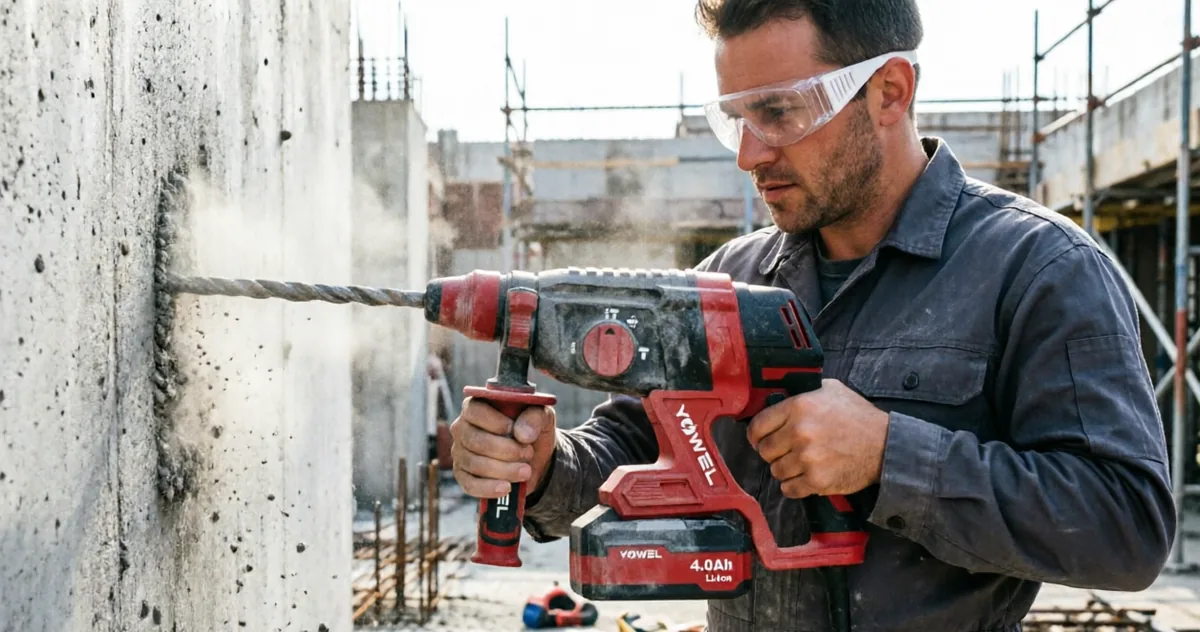
About the data. Every electrical, performance and commercial figure in this guide comes from the approved YOWEL product parameter sheet (user-approved version) and the confirmed business-terms sheet; capacity classes follow the "Max drilling capacity / Concrete" row, and the cordless range was confirmed three-mode on 14 November 2026. Carton weights are stated as published: 4.0 kg gross for the corded models and 4.8 kg gross for the cordless models, at five pieces per carton. Battery capacity is 4.0Ah across the range, confirmed by the business team on 15 November 2026 and added to the parameter sheet; runtime per charge, charge time, pack and charger contents, and a cordless duty-cycle rating are not published and are described here as gaps rather than estimates. Certifications are recorded by name only (CE, GS, EMC, ROHS, ISO); no certificate numbers, scans, compliance conclusions, customer cases, prices, search volumes or third-party market statistics are asserted. The job-site photograph is an illustrative image of 21V cordless SDS-Plus drilling, not a customer installation. Our Taizhou factory has produced and developed rotary hammers for over 20 years.
Last reviewed on 14 November 2026 by the YOWEL factory engineering team · ZHEJIANG YOUWEI TOOLS CO.,LTD. · No.85 Taojiang Road, Qiansuo Industrial Zone, Jiaojiang District, Taizhou, Zhejiang, China · [email protected] · +86 178 1658 8178