
Wholesale Rotary Hammer Buying Guide: 26mm vs 28mm for Importers
Quick answer
- 26mm is the volume model. Seven of our eleven corded hammers measure 26 mm in concrete: six at 800 W / 3.0 J and one at 850 W / 3.1 J, all with a 6–18 mm optimum range.
- 28mm is the margin model. Two models — RH3018 and RH3020 — at 900 W / 3.2 J, rated 28 mm in concrete with a 6–20 mm optimum range.
- Both are SDS-Plus and both are three-function. Drilling, hammer drilling and chiselling. Only the 500 W RH2001 is two-function.
- Certification is settled before production, not before shipping. We hold CE, GS, EMC, ROHS and ISO by name; EAC for Russia is a separate route and we do not claim it.
- Commercial terms are the same across the range. MOQ 500 pcs, 5 pcs per carton, 35–40 days, HS code 84672100, 1% free spare parts.
1. Why most rotary hammer buying guides don't help importers
Search for a rotary hammer buying guide and most results are written for a homeowner drilling six holes on a Saturday. You are not buying six holes. You are buying a line that has to survive a retail season, a warranty window and a second order.
Two buyers visit our Taizhou plant in the same month, one buying for Russia and one for Poland. They look at the same range and order what looks like the same machine. Twelve months later one is booking a third container; the other is still clearing warranty returns. The difference was never unit price. It was the capacity code, whether the certificate matched the model, and whether spare parts were ordered in time.
DIY buyer vs distributor: two different checklists
| Decision | End user checks | Importer checks |
|---|---|---|
| Price | Ticket price | FOB band at your MOQ |
| Performance | Does it drill this wall | Impact energy, blow rate, duty cycle |
| Compliance | "It has a CE mark" | Which certificate, covering which models |
| After-sales | A warranty card | Wear-part stock, claim terms |
| Repeat logic | Not applicable | Does it earn a second container |
The overlap is smaller than it looks. Light weight wins consumer reviews and can work against you in a professional channel, where the buyer is paying for duty capability rather than a number on the box.
2. The seven specs that belong on your spec sheet
A wholesale spec sheet should carry seven items: impact energy in joules, blow rate, input power, chuck system, function modes, weight and duty cycle, and dust-extraction readiness. Miss one and it reappears later as a claim.
Impact energy: the number everybody quotes, few read correctly
Impact energy is the energy in one blow, not drilling speed. Output on concrete is closer to single-blow energy × blow rate × bit seating. Across the market, corded SDS-Plus hammers sit around 2.0–3.5 J. Our own range runs from 1.7 J on the 500 W RH2001 to 3.2 J on the 900 W 28 mm models. Joules are not comparable across brands, because no single test method is published by everyone.
Blow rate vs single-blow energy
A high blow rate with low single-blow energy gives many small taps. In hard or reinforced concrete that is slower than fewer, heavier blows, because the bit never gets a clean fracture. This is why a 4,800 bpm machine with 3.0 J can out-drill a faster tool with less energy per blow.
Rated input power, and how to catch an inflated rating
Input wattage is the easiest figure to inflate. The usual form is copper-clad aluminium winding sold as copper: cheaper, hotter and weaker under load. Get the winding material in writing, weigh two samples, and open one motor — copper-clad aluminium shows a silvery core at the cut end.
Chuck system: SDS-Plus vs SDS-Max
SDS-Plus uses a 10 mm shank and covers roughly 4–30 mm holes; SDS-Max uses an 18 mm shank for larger work. The two are not interchangeable. All nineteen YOWEL models are SDS-Plus, which is why our corded range stops at 28 mm measured in concrete: above that you are in SDS-Max territory and a much smaller market.
Function modes: what the catalogue actually contains
Two-function gives drilling and hammer drilling; three-function adds chiselling. Eighteen of our nineteen models are three-function — ten corded and all eight cordless — and one, the 500 W RH2001, is two-function. Confirm the mode row on the model page rather than assuming it from the price band, because a chiselling mode changes what a contractor can bill for.
Weight, vibration and duty cycle
All our corded models are rated for 40% intermittent duty. Read weight and duty cycle together: 3 kg rated intermittent is not 3 kg rated continuous. In the EU, Directive 2002/44/EC sets a hand-arm exposure action value of 2.5 m/s² A(8) and a limit of 5.0 m/s² A(8). A poor figure can push a contractor over the action value in part of a shift.
Dust extraction and the safety clutch
In the US, OSHA's respirable crystalline silica standard sets a limit of 50 µg/m³ over an eight-hour average (29 CFR 1910.1053 for general industry, 29 CFR 1926.1153 on construction sites). The rule pushes contractors toward on-tool extraction, so machines that can take a dust shroud are easier to sell into that channel. A safety clutch also stops the tool twisting out of the operator's hands when a bit jams in rebar.
3. 26mm vs 28mm: which capacity should you stock?
Most guides jump from 26 mm straight to 32 and 52 mm, skipping the two codes that dominate the corded export catalogue. Our range goes 20, 22, 26 and 28 mm — there is no 24 mm SKU, so a 24 mm request is quoted from the 26 mm platform or declined.
The capacity ladder, and the label trap behind it
- 20mm — entry level and promotional volume. Light, cheap, thinnest margin.
- 22mm — the step buyers take when they cannot justify a 26 mm price.
- 26mm — the volume anchor of the trade channel. If you stock one code, stock this one.
- 28mm — the professional step. This is where unit margin comes from.
One warning that costs importers real money: a model name or a catalogue folder is a navigation label, not a measurement. RH2820 sits in the 28 mm folder and measures 26 mm in concrete. RH3018 and RH3020 sit in the 30 mm folder and measure 28 mm. The rated value is the Max drilling capacity / Concrete row of the approved parameter sheet, and that is the row we quote. For a deeper explanation of why, read how to choose a rotary hammer by drilling capacity.
26mm: the volume anchor
Seven models measure 26 mm in concrete. Six run 800 W, 3.0 J, 0–1,100 rpm and 0–4,800 bpm; RH2820 runs 850 W, 3.1 J, 0–1,150 rpm and 0–4,900 bpm. All seven share a 6–18 mm optimum drilling range — which is where the M10–M16 anchor and fixing work actually sits. See the 26mm rotary hammer range or the specification page for the RH2601 800W model.
28mm: the margin model for the professional channel
Two models measure 28 mm: RH3018 and RH3020, both 900 W, 3.2 J, 0–1,300 rpm, with 0–4,800 and 0–5,300 bpm respectively. The step up is not about hole diameter — most users never drill 28 mm. What you pay for is sustained work: a heavier hammer mechanism, more capacity to shed heat, and a longer life under continuous duty. Optimum range extends to 6–20 mm. Professional buyers pay a premium for a machine built for a full shift, so unit margin is better; the trade-off is turnover. See the RH3018 900W specification.
Side-by-side, from the parameter sheet
| Parameter | 26mm class (7 models) | 28mm class (2 models) |
|---|---|---|
| Input power | 800 W (RH2820: 850 W) | 900 W |
| No-load speed | 0–1,100 rpm (RH2820: 0–1,150) | 0–1,300 rpm |
| Impact rate | 0–4,800 bpm (RH2820: 0–4,900) | 0–4,800 / 0–5,300 bpm |
| Impact energy | 3.0 J (RH2820: 3.1 J) | 3.2 J |
| Max in concrete | 26 mm | 28 mm |
| Optimum range | 6–18 mm | 6–20 mm |
| Chuck / functions | SDS-Plus / 3-mode | SDS-Plus / 3-mode |
| Duty cycle | 40% intermittent | 40% intermittent |
| Net weight | Approx. 2.8–3.0 kg | Approx. 3.1–3.2 kg |
| MOQ / carton | 500 pcs / 5 pcs per carton | 500 pcs / 5 pcs per carton |
Figures from the approved YOWEL parameter sheet, "Max drilling capacity / Concrete" row. Names in brackets identify the model that differs from the class default.
How to split your first container
Split your customers into two groups first: those who buy on price, and professionals who buy for specific projects. Weight the container toward whichever group is bigger. As an illustrative starting structure, roughly 60–70% 26 mm, 20–30% 28 mm, and about 10% cordless if your market already asks for battery tools. If you are still deciding, request samples in both capacity codes and run them on your own concrete before you commit.
4. Voltage, plug and climate: matching the machine to the market
For any rotary hammer import from China, voltage and plug type must be written into the purchase order.
Voltage and plug: why "220–240V/50Hz" is not a universal answer
Our corded platform is built for 110 V or 230 V, 50/60 Hz with a 2 m cable, and ships with an EU, BS or OEM plug. Brazil runs 127 V in some states and 220 V in others; several South Asian and Middle Eastern markets expect a plug shape a standard European moulded plug will not match. Specify the plug standard by name. A dual-voltage platform means one SKU can serve two markets, which halves both certification and stocking overhead.
Cordless changes where the problem sits
A DC21V tool is the same voltage everywhere, but the charger is not. Our cordless range still ships with EU, BS or OEM plugs, so the market-specific SKU difference moves from the tool to the charger. That is also where the certification question moves. For the full comparison, see corded vs 21V cordless: which fits your market and the eight-model 21V range.
Cold-climate markets: what fails first below −20 °C
- Grease thickens, and the hammer mechanism stops cycling cleanly.
- PVC cable sheaths are fine at 20 °C but crack when coiled at −20 °C.
- Housings lose impact strength.
- Battery capacity collapses, and charging a frozen pack damages the cells.
Get the low-temperature grease grade and cable rating in writing. Lithium shipments to Russia may also face a low-temperature safety test, typically around −40 °C.
High-humidity and coastal markets
Humidity attacks the switch and stator, internal steel and insulation tracking at the same time. Do not accept a claim of "waterproof" — ask for sealed switch gear, moisture-resistant insulation, corrosion-protected fasteners and the flame-retardant rating of the enclosure.
5. Certification: what clears customs, and what we actually hold
Certification problems cost the most money and give the least warning. By the time something goes wrong, the goods are paid for and already on the water. So here is our own position first, then the rules that matter per market.
What YOWEL records, and what it does not claim
Our business team records CE, GS, EMC, ROHS and ISO. We do not claim EAC, SASO, BIS or INMETRO, and we do not state that a given mark satisfies a given national scheme, because the applicable scope depends on the model, the charger and your market's rules. Certificate scope is confirmed in writing per model with the quotation — treat the name list as the list to discuss, not as a compliance opinion.
EU: CE is a declaration, not a certificate
The EU framework is the Low Voltage Directive 2014/35/EU, the EMC Directive 2014/30/EU, the Machinery Regulation (EU) 2023/1230, plus RoHS 2011/65/EU and REACH. For Great Britain, UKCA replaces CE. CE is a self-declaration backed by a technical file — no EU body issues a "CE certificate". That file normally rests on IEC 62841-2-6, the part of the safety series covering hand-held hammers. If a supplier emails you a "CE certificate", ask who issued it and on what basis. GS is voluntary, but involves third-party testing and factory inspection.
EAEU (Russia, Belarus, Kazakhstan): CE does not substitute for EAC
Power tools are a higher-risk category in the EAEU, so a rotary hammer entering Russia needs an EAC Certificate of Conformity, not a declaration. Four technical regulations apply at once: TR CU 004/2011 (low-voltage safety), TR CU 010/2011 (machinery safety), TR CU 020/2011 (EMC) and TR EAEU 037/2016 (hazardous substances). What suppliers rarely volunteer:
- CE and CB reports are supporting reference only.
- Testing is expected in EAEU-accredited laboratories, not in China.
- The certificate must be registered in the FGIS register, or customs treats it as invalid.
- Labeling is strict: the EAC mark height, permanent application, and a Russian origin statement.
- Cordless models add battery testing and the low-temperature test.
Our position is honest: we do not hold EAC. For a Russian order we quote against the certification route your importer or authorised representative controls, and we do not book production until that route is agreed in writing.
Middle East, India, Brazil, and cordless dangerous goods
Saudi Arabia requires SASO conformity through SABER; the wider Gulf uses the G-Mark. India applies BIS registration, including CRS. Brazil applies INMETRO, with testing at accredited Brazilian laboratories. All three need a local entity and a local file. Lithium batteries are Class 9 dangerous goods, so cordless shipments need a UN38.3 test summary, an MSDS, Class 9 marking and an IATA or IMDG declaration.
Four checks before you pay a deposit
- Check the certificate number in the issuing body's own database, not in the PDF you were emailed.
- Confirm the laboratory's accreditation scope covers power tools and the standard cited.
- Match the model designation character by character against your purchase order. A certificate for one model does not cover its next variant.
- Confirm the certificate holder is the factory, not a trading company with a similar name.
Check three catches most of them.
6. How to audit a rotary hammer factory, not a trading company
A business licence tells you a company exists, not that it makes anything. In China the licence also prints a business scope — read it. A practical supplier verification list starts narrower: which components do you make in-house; how many lines run rotary hammers; can I see incoming inspection records for the last gear batch. A trading company handles the first smoothly and struggles with the third.
Capability map: what should be in-house
The chain is: motor winding → gear cutting and heat treatment → injection moulding → assembly → run-in → dielectric and insulation testing. A factory controlling the first two has real leverage over cost and quality; one buying complete gearboxes is an assembler whose ceiling is set by the cheapest bidder. Our plant runs four rotary hammer production lines, and finished tools run under load on the run-in line before packing.
Quality checkpoints suppliers hope you skip
- Winding material — in writing: pure copper or copper-clad aluminium.
- Gear heat-treatment hardness records — the classic early-failure point, especially in cold markets.
- Run-in testing — look for per-unit records, not just a line in the brochure.
- Dielectric and insulation logs — one test per unit, at end of line.
- Piston-cylinder clearance and grease selection — two numbers that set both performance and cold-weather behaviour.
- Drop and moisture tests — cheap to run, and a better predictor of field failure than any spec on the sheet.
Our QC sampling follows ANSI/ASQC Z1.4 and GB/T 2828.1, and every unit runs through a half-hour testing process before shipment. Our rotary hammer factory in Taizhou is open to visiting buyers; if you cannot travel, ask for a live video walk-through of the line.
The four OEM traps we have seen
1. Relabel without core change. Your logo goes on an existing housing; the motor and gearbox are untouched. Ask for the OEM bill of materials. 2. Inflated power rating. Verify by weighing the tool, opening the motor and running a sustained full-load test. 3. Inflated battery capacity. Require cell grade and capacity on the quotation, then run a discharge test. 4. Certificate reuse. A genuine scan with the model number altered — run the four checks above yourself.
7. About YOWEL: the numbers behind this guide
The advice above comes from the factory side of the table. Here is our own file, in the same shape we would ask any supplier to fill in.
The factory in figures
- Brand and legal entity — YOWEL is the export brand of ZHEJIANG YOUWEI TOOLS CO.,LTD., the name on the business licence and on the order documents.
- Experience — over 20 years of rotary hammer production and R&D, in Taizhou, Zhejiang.
- Plant — 30,000 m², 200 staff, 4 rotary hammer production lines.
- Capacity — 600,000 units a year, about 50,000 a month.
- Export markets — the Middle East, South East Asia and South America as the main regions, with shipments to Russia, Malaysia, Thailand, Indonesia, Poland, Kazakhstan and the UAE.
- Factory audit — on-site visits are welcome; for buyers who cannot travel we run a live video audit. A QA report is available under NDA.
- Our own MOQ — 500 pcs per SKU per shipment for factory-brand and OEM label; 100 pcs for a trial order at a higher unit cost; private-mould projects are quoted separately.
Certificates and what we do not hold
ISO, CE, GS, EMC and ROHS are the names recorded by our business team. We do not hold EAC, and we do not publish a claim that a mark satisfies a specific national scheme. Naming that gap is more useful to you than a longer list. Scope by model is confirmed in writing with the quotation.
8. MOQ, pricing and landed cost
Why MOQ drops from 500 to 100 cost you more per unit
MOQ is not a negotiating trick. It covers what it costs to stop and change a line: setting up machines, preparing tooling and buying parts in supplier minimums. Moving from a 500-piece tier to a 100-piece tier typically raises unit price by 15–35%. Private-mould projects carry a much higher MOQ, because mould amortisation has to be recovered in the first run.
We do not publish a price list. Two listings in the same capacity class can describe very different machines — the difference sits in the winding, the gearbox and the grease. Treat any figure without a written configuration as a rough indicator, and compare offers on the specification sheet rather than the headline number. Send your model, voltage, plug, certification scope and quantity and we will quote against that configuration.
Payment terms and what each one costs you
- T/T, 30% deposit, 70% against bill of lading copy — the most common structure; capital tied up from deposit to arrival.
- L/C at sight — more bank fees and documentation, but it protects both sides.
- Open account — usually offered only after several clean orders.
Our terms are T/T or L/C, with FOB, CFR or CIF. Compare terms alongside price: a 3% lower unit price on 30-day terms can be worse value than a higher price on 90-day terms.
Seven components of landed cost
- Goods value at your agreed Incoterm
- Ocean freight and bunker surcharges
- Import duty — our shipments are declared under HS code 84672100; confirm the subheading and rate with your broker, because rates differ by country
- Customs clearance and brokerage
- Port and terminal charges
- Inland transport
- Cargo insurance
Landed cost commonly runs 20–35% above FOB, and past 40% when duty is high, the route is long, or you ship LCL instead of FCL.
9. Lead time, packaging and container loading
What a realistic timeline looks like
Standard OEM orders run 35–40 days from PO to ex-factory. Samples ship in 5–7 days. Add 5–7 days for Pantone-matched colour tooling on a first order, and 4–6 weeks if new certification testing is required. Then add transit: about 25–35 days China to Europe, and 7–14 days within Southeast Asia.
BMC case, colour box or sleeve
Every model in our range is packed in a colour sleeve with a BMC box, 5 pieces per carton. A blow-moulded case adds perceived value and real volume; a colour box ships far more efficiently. Decide by channel: retail wants a case or a strong box; project and fleet buyers prefer a plain box.
How many units fit a 20GP, worked honestly
Take RH2601 and RH3018 as examples. Both pack at 5 pieces per outer carton, with a gross weight of 4.5 kg and 4.8 kg per unit respectively — so a carton lands around 22–24 kg, and weight is usually the binding constraint before volume in a 20GP. Do the arithmetic from the packing plan, not from this paragraph:
| Step | Formula | Where the number comes from |
|---|---|---|
| Cartons per container | usable m³ ÷ carton m³ | Carton dimensions in the confirmed packing plan |
| Units per container | cartons × 5 | 5 pcs per carton, fixed across the range |
| Weight check | units × unit gross weight | 4.0–4.9 kg corded, 4.8–5.0 kg cordless |
We deliberately do not publish a "units per 20GP" headline figure here, because the carton dimensions in a packing plan change with the packaging option you choose. Ask for the packing plan for the exact model and case type, and the number becomes exact.
10. OEM and ODM: what you can actually customise
Three levels, three cost structures
Level 1 — label and packaging. Your logo, artwork, manual and colour box on an existing tool. Lowest MOQ tier and fastest route to market, but no differentiation. Level 2 — cosmetic change. Housing colour, soft-grip overmoulding, mould inserts and badging. Our recorded OEM capability covers colour, package, plug, voltage and power. MOQ rises because new resin runs and inserts have to be produced. Level 3 — new development. A new housing, a new mechanism, or a specification built for your market — a project, not an order. Budget for tooling, engineering samples and certification in your own name.
Two clauses that decide who owns the asset
Who owns the mould — if the factory owns it, it can be sold to someone else. Who holds the certificate — if it is in the factory's name, the compliance file is not yours. Negotiate territorial exclusivity in writing, with a duration.
11. After-sales, wear parts and repeat orders
The parts your service network asks for first
Requested most often, in order: carbon brushes, switches, oil seals and O-rings, chuck components, auxiliary handles, then bits and chisels. A carbon brush costs cents, and a distributor loses a contractor who buys 200 tools a year if that brush is out of stock for six weeks over the Chinese New Year shutdown.
What our terms actually say
Orders include 1% free spare parts. We keep a 30-day rolling spare-parts buffer for every active OEM SKU — gear sets, chucks, safety clutches, switches, carbon brushes and motor assemblies — and dispatch from our Taizhou warehouse within 48 hours. The service and support page carries the exploded view of the SDS-Plus platform and the spare-parts route.
How much spare-part stock to put in the first container
A working formula, which you can check against any supplier's offer:
spare-part quantity ≈ (first-order units × expected annual claim rate ÷ 12) × months of cover × number of service points
Illustrative: 1,000 units at a 6% annual claim rate is about 5 claims a month, so six months of cover is roughly 30 sets per service point. Put the ratio, claim-handling deadlines, who pays freight on warranty parts and technical response times into a contract annex, not an email thread.
12. RFQ checklist: what to send a rotary hammer manufacturer
A vague enquiry gets a vague quote. Send these nine fields and a factory can price your order the first time. They also make two suppliers comparable, which price alone never does.
- Target market, destination port and Incoterm — FOB, CIF, EXW or DDP
- Voltage, frequency and plug standard for that market
- Capacity code — 26 mm or 28 mm — plus target impact energy
- Function modes — two-function or three-function
- Chuck system — SDS-Plus or SDS-Max
- Certification checklist — CE, GS, EMC, RoHS, EAC, SASO, BIS, INMETRO, UKCA
- OEM level — label and packaging, cosmetic change, or private mould
- Packaging — BMC, colour box or case; units per carton; spare-part ratio
- First-order quantity, estimated annual volume and target FOB band
That last field is the one buyers leave out, and the one that moves the price. A supplier who knows you plan 5,000 units a year quotes differently from one who assumes 500 units once. Send the nine fields to our sales team and we will answer with a spec-matched quote, the certificate list for your market and a lead time for your quantity.
13. Frequently asked questions
What is the difference between a 26mm and a 28mm rotary hammer?
A 26 mm model is typically 800 W with 3.0 J; a 28 mm model is 900 W with 3.2 J. Both are SDS-Plus and both are three-function. The real difference is duty capability and margin, not hole size: 26 mm is the volume SKU for general trade, 28 mm sells to professional users who need a machine built for a full shift.
What impact energy do I need for concrete anchor work?
For M10–M16 anchor and fixing work, roughly 3.0 J is a comfortable reference, which is why 26 mm machines dominate that application. Our 26 mm class pairs 3.0 J with a 6–18 mm optimum drilling range. Lighter 1.7–2.0 J units handle occasional small holes but slow noticeably in cured or reinforced concrete. Always ask which test method produced the figure.
Do I need EAC if I already have CE for the Russian market?
Yes. CE does not substitute for EAC. Power tools are high-risk under EAEU rules and need an EAC Certificate of Conformity under TR CU 004/2011, 010/2011, 020/2011 and TR EAEU 037/2016, registered in the FGIS system. YOWEL does not hold EAC; we quote against the certification route your importer controls and will not book production until it is agreed in writing.
What is the typical MOQ for OEM rotary hammers?
500 pieces per SKU per shipment, and you can mix SKUs in one container. A trial order can ship from 100 pieces at a higher unit cost. Private-mould development starts considerably higher, because tooling has to be amortised in the first run. Confirm the tier in writing before you send an enquiry, and ask whether the price holds if you split the order across two shipments.
Corded or cordless for my market?
Corded still wins on price, runtime and service simplicity, especially in price-sensitive markets. Cordless wins where sites lack reliable power or where your customers already own a battery platform. Note what you are actually comparing: our cordless range is a single 22 mm class at 2.7–2.8 J, while the corded range spans 20 mm to 28 mm. Cordless also adds UN38.3 testing, an MSDS and Class 9 shipping paperwork, so budget for it.
14. Conclusion
Three things separate importers who build a line from importers who buy a container. 26 mm is the volume anchor, 28 mm is the margin model. Certification must be settled before production, not before shipping. Spare parts belong in the first container.
You are choosing a production partner for a three-to-five-year line, not one shipment. Winding material, hardness records, mould ownership and certificate ownership never appear on a quotation. The questions you ask before signing decide which side of that gap you end up on.
15. Glossary: the abbreviations in every quote
- MOQ — minimum order quantity: the smallest run a factory will accept at a given price.
- Incoterm — the published rule saying who pays for what and who carries the risk, always named with a year.
- FOB / CIF / EXW / DDP — seller loads (FOB); seller also pays freight and insurance to your port (CIF); you collect at the factory (EXW); seller handles everything to your door (DDP).
- LCL / FCL — less than container load, or full container load. LCL costs more per unit.
- HS code — the Harmonized System number customs uses to set duty; ours is 84672100.
- CoC / DoC — Certificate of Conformity, issued by a certification body, versus Declaration of Conformity, signed by the maker.
- EAC / FGIS — the Eurasian Conformity mark, and the Russian register where a valid EAC certificate must be recorded.
- Duty cycle — how long the tool can run before it must cool down; our corded range is rated 40% intermittent.
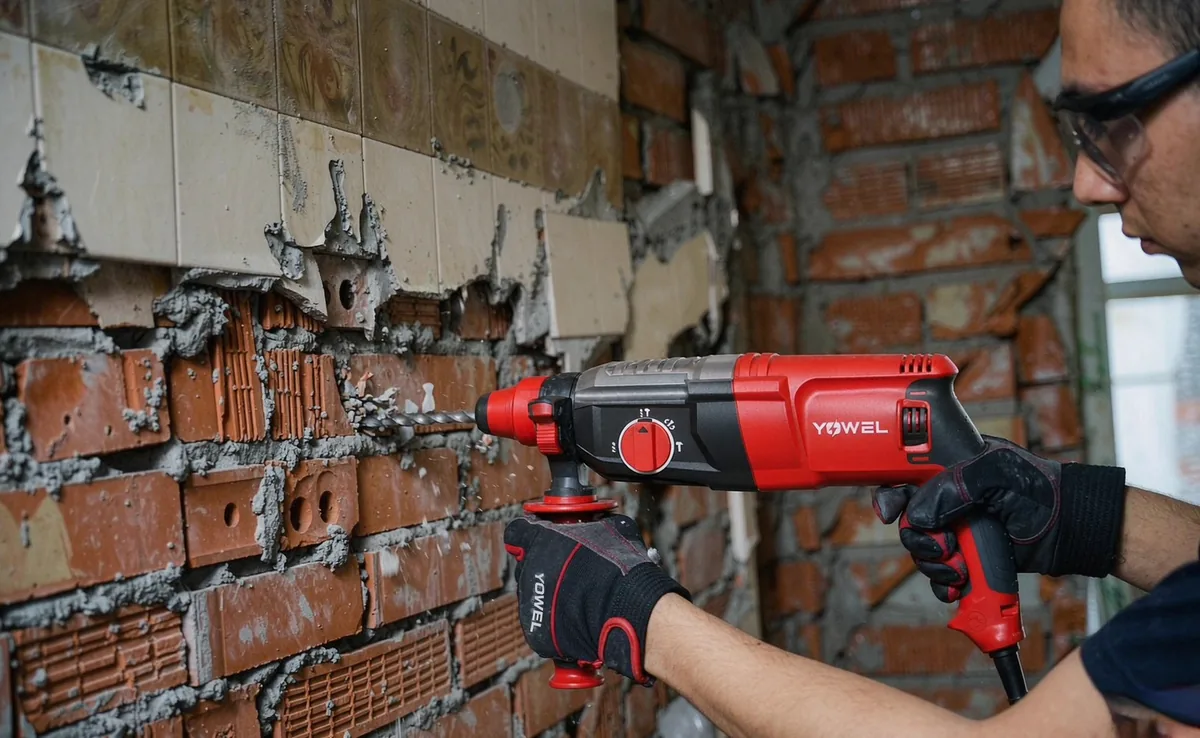
About the data. All electrical and performance figures in this guide come from the approved YOWEL product parameter sheet (user-approved version); capacity classes follow the "Max drilling capacity / Concrete" row, which is why RH2820 is treated as 26 mm and RH3018/RH3020 as 28 mm regardless of catalogue folder. Commercial figures come from the separate confirmed business-terms sheet (MOQ 500 pcs, 5 pcs per carton, 35–40 days, T/T or L/C, FOB / CFR / CIF, HS 84672100, 1% free spare parts, QC sampling to ANSI/ASQC Z1.4 / GB/T 2828.1). Factory facts: 20+ years of rotary hammer production and R&D, 30,000 m², 200 staff, 4 production lines, 600,000 units annual capacity. Certification names only (CE, GS, EMC, ROHS, ISO) are recorded; we do not hold EAC and no compliance conclusion is asserted. Price bands are third-party platform listings, not our quotation. The job-site photograph is illustrative.
Last reviewed on 15 November 2026 by the YOWEL factory engineering team · ZHEJIANG YOUWEI TOOLS CO.,LTD. · No.85 Taojiang Road, Qiansuo Industrial Zone, Jiaojiang District, Taizhou, Zhejiang, China · [email protected] · +86 178 1658 8178